Kamis, 22 Agustus 2013

Mercedes-Benz SLS AMG GT Coupe and Roadster 2013

2013 Mercedes-Benz SLS AMG GT Coupe and Roadster


Before marketers hijacked them, before BMW slapped them on an awkward hatchback, and long before you could buy a Mitsubishi Outlander GT, the letters “GT” defined a very specific type of automobile. A grand tourer, or gran turismo, was a swift, athletic car that placed equal priority on upscale trimmings, long-distance comfort, and imposing styling. A GT was the driving connoisseur’s road-trip machine, tailor-made for a holiday through the Alps or a blast across the United States. Today, GT is merely an ambiguous term that’s about as meaningful as the letters S, LTZ, or SEL.
Add the 2013 Mercedes-Benz SLS AMG GT coupe and roadster to the long list of cars that have used and abused the GT tag (the Pontiac Aztek GT!). Sure, the gullwing version of this high-zoot Mercedes is purpose built to vanquish miles in high fashion, but the SLS GT does not do comfort. The 2011 SLS AMG was a hard-hitting, stiff-legged road rocket; its replacement is even more raucous and brutal.
Stiff and Stiffer
We never accused the outgoing car of being soft or flabby, but someone must have thought it too sedate to be AMG’s calling card. On top of increasing the spring and damping rates on the GT, the engineers in Affalterbach eliminated the Comfort setting for the adjustable shocks. The SLS GT now offers Sport and Sport Plus modes—you can also call them stiff and stiffer. Either setting makes for a tedious ride over anything but fresh-laid asphalt. The SLS slaps at expansion joints, pounds on potholes, and thunks over heaves in a tantrum that you’d expect from a Lamborghini, not a Mercedes.
At the track, though, the SLS is everything you’d expect of a $200,000-plus car designed from the ground up by power-drunk AMG. We tested an SLS AMG GT coupe and roadster in back-to-back weeks, with the two cars posting nearly identical measurables. On the skidpad, the roadster’s lateral acceleration of 0.98 g matched our best performance with a 2011 model. Braking distances from 70 mph to 0 were also in line with our past results. The coupe, equipped with the optional carbon-ceramic brakes, posted a stopping distance of 159 feet; the roadster, with standard iron discs, came to a halt in 156 feet. The numbers are a real-world reminder that carbon-ceramic brakes are intended to combat fade and reduce weight, not shorten stopping distances.
Bark and Snarl
In upgrading its flagship to GT spec, AMG increased the output of the hellacious 6.2-liter V-8 to 583 horsepower (up by 20), keeping torque at 479 lb-ft. There’s a sweeter, more percussive exhaust note with enough bark and snarl to convince you that this hunk of aluminum is in an active battle against forced induction to protect its naturally aspirated, big-displacement livelihood. AMG wisely left the transmission’s Comfort setting intact, and the SLS is still content to dawdle along at 2000 rpm and handle additional throttle requests with big low-end torque rather than a downshift. Rotate the knob to a more aggressive setting, or shift for yourself, though, and the SLS becomes as feisty and urgent as an Italian exotic.
We weren’t able to match our best 3.5-second 0-to-60 time achieved with the old SLS, nor were we able to hit Mercedes’ claimed 3.6-second time for both gullwing and roadster. Instead, we saw 3.7 and 3.8 seconds to 60 mph in our two testers, although we don’t doubt Mercedes’ claims. As with the outgoing SLS, the launch-control program still won’t extract the quickest times. You have to lightly brake-torque the engine and flatten the right pedal with the dual-clutch transmission in manual mode. Keep the throttle flat past 125 mph, and you’ll clear the quarter-mile in fewer than 12 seconds.
The SLS AMG GT isn’t a better performer than the car that came before it, but it is a tangibly different car. More than ever, the SLS turns away from the three-pointed star on the hood to pledge allegiance to the AMG crest embossed on its gear selector. Call it angry, luxurious, fast, striking, or timeless. Just don’t try to call it a true GT.

Jaguar XFR-S 2014


Action-figure lats for one of Jag's quicker cats. August 2013


2014 Jaguar XFR-S 
Whether or not you’ve heard of Jeffry Life, you know his face—or, more accurately, his body. Dr. Life is the balding 74-year-old with the chiseled torso in those hormone-replacement ads that look like an old head that’s been manipulated by Photoshop onto a young body. Like Life, Jaguar has recently rediscovered a more youthful self, and the XFR-S appears, on first blush, to be digitally enhanced, as well.
But that Schwarzeneggerian physique really is Life’s, and this is no faux mash-up of a Jaguar and a Mitsubishi Evo. The Jag’s wing is real (albeit optional) and is backed up by genuine muscle. Changes to the engine-management controls and exhaust system squeeze an additional 40 horsepower and 41 lb-ft of torque from Jaguar’s blown 5.0-liter V-8, for totals of 550 and 502. That’s good for an estimated 0-to-60-mph time of barely more than four seconds and a terminal velocity of 186 mph. A symposer pipes intake noise into the cabin, but the guttural exhaust howl is all you really want to hear. A new torque converter and uprated half-shafts aim to keep the driveline intact.

Life-Affirming Chassis
The front and rear springs are stiffened 40 percent compared with the XFR’s, meaning they are 100 percent more rigid than those on a regular XF, and the adaptive dampers are firmer in their baseline and Dynamic settings. The R-S packs a new rear subframe, stiffer bushings, and fresh knuckles front and rear. The braking hardware is untouched—and given the 160-foot stop we’ve previously recorded from an XFR, entirely capable—but underbody ducting is said to improve cooling. Twenty-inch wheels are 0.5 inch wider up front and 1.0 wider out back and are strapped with 265/35 front and 295/30 rear rubber. Jaguar says lift is down by 68 percent from the XFR’s, crediting aero tweaks such as resculpted fascias front and rear, unique rocker panels, and a wing that looks as out of place on a Jag as Dr. Life’s action-figure lats do on him. (A smaller lip spoiler is standard but seems incongruously prudent for such a screamer.) French Racing Blue and Italian Racing Red are among the five color choices, but, perhaps because it is too demure, British Racing Green isn’t.
The base XFR is one of the smoothest-riding cars in its class, but firming up the suspension to XFR-S stiffness levels doesn’t wreck the ride. It does add needed discipline to the body control, and the result is behavior deserving of a big, gaudy wing. Turn-in is greatly improved, and the tail is happy to aid directional changes. As one of a decreasing population that still uses hydraulically boosted power steering—and thanks to a claimed 80-percent increase in the stiffness of its front knuckles—the R-S’s steering wheel boasts delightfully linear effort buildup in corners. Slight twitchiness under braking reinforces the impression that the car is spring-loaded for directional changes, a hooligan of the highest order.

Jaguar will bring only 100 XFR-Ss to the U.S. in 2014, at a price that outpaces the XFR’s by nearly 16 grand. Translated to a budget for the hormone treatments that helped Life get his physique, that $1500-per-month premium will get you only 10 months’ worth. Even at $99,895, the XFR-S is the cheaper way to keep both you and Jaguar looking and feeling younger for longer.

Post by JARED GALL

Selasa, 05 Februari 2013

Subaru BRZ Premium 2013

BY MIKE SUTTON | MULTIPLE PHOTOGRAPHERS
2013 Subaru BRZ Premium

Subaru’s rear-wheel-drive BRZ sports car was a lock for long-term duty in our vehicle fleet, what with its being fun, affordable, and relatively efficient, as well as one of the most significant new models for 2013. So we ordered up a Premium model in Subie’s iconic WR Blue Pearl hue. Fitted with a six-speed manual transmission and priced at $26,265 to start, it’s the least-expensive BRZ trim, forgoing the optional $1100 six-speed automatic and the added conveniences—heated leather seats with faux suede inserts, heated exterior mirrors, keyless entry and start, fog lights, dual-zone climate control, and more—of the $28,265 Limited model. It’s definitely worth noting that, since our car’s arrival, the BRZ made it onto our 2013 10Best Cars list, along with its Scion FR-S twin.
Despite its entry-level status, our Subie packs as standard six airbags, multistage stability control, a touch-screen infotainment system with navigation and Bluetooth, fold-down rear seatbacks, supportive front sport seats, LED daytime running lights, a Torsen limited-slip differential, and 17-inch aluminum wheels. Also included, of course, are some of the best driving dynamics available today.
Toss and Catch? It’s Not Just a Ball Game
Once the Subaru was broken in, we turned it loose on the test track, where it posted a 6.4-second run to 60 mph and a quarter-mile gallop of 15 flat at 94 mph. Those times are comparable to those of other BRZs we’ve tested with the manual gearbox, as are the 172-foot stop from 70 mph and 0.89 g of grip around the skidpad. The 2757-pound coupe was able to reach a drag-limited 139-mph top speed.
Although the BRZ isn’t a particularly fast car, it’s organic and direct in its responses to inputs in a way that feels naturally hard-wired to the driver. Like the MX-5 Miata, the BRZ is an easy car to get to know. Take it down your favorite stretch of twisty bits, and you’ll be friends in no time. (We’re talking about roads. Settle down.) Initial logbook entries heaped praise on its balanced chassis and surprisingly communicative electric-assisted power steering, which is also nicely weighted and helmed by a small, grippy steering wheel devoid of secondary controls. The brake pedal is firm and easy to modulate, and the tight action of the manual shifter makes running through the gates very rewarding.
A Maddening Radio and Other Maladies
The remainder of the logbook’s first impressions, however, focused on the BRZ’s infuriating touch-screen interface for the audio and navigation system. Standard equipment on the BRZ, the head unit looks and feels far below even the Subaru’s affordable price point and is hampered by clumsy operation and a lack of redundant hard controls. The virtual buttons are small and difficult to locate while driving, and the system responds sluggishly compared with most factory multimedia setups. Some drivers have generously called it a nuisance; others call it flat-out dangerous to operate while on the road. As much as we appreciate the simplicity of the contoured steering wheel, having additional—and more effective—audio controls at our fingertips would be a boon.
We’ve made one scheduled stop—at 7685 miles for a $90 oil-and-filter change and inspection—but our unscheduled visits to the dealership have been many. The first occurred at 2600 miles when a chunk of the Subaru’s roof molding ripped loose in a carwash. It cost $47 to replace. About 1000 miles later, the leather-wrapped shift knob began to rattle at highway speeds, at which point we also ordered a new set of taillights because the ones on our car weren’t sealed well and were constantly filled with condensation. This apparently is a common problem with the BRZ, and a service bulletin has been issued. As of this writing, the new shift knob and the lights are on back order at the dealer, and both are covered by warranty. Finally, with about 6800 miles on the clock, the passenger-side power window stopped working on an icy morning after a freezing rainstorm. It fixed itself once the temperatures rose and has yet to fail again, although we haven’t seen similar weather since.
Winter Challenge
As we rack up the miles between service stops, the realities of regularly driving a small rear-drive sports car in Michigan are setting in. With just 1233 pounds over the rear axle and about five inches of ground clearance, we’re going to have to reset our expectations for a Subaru once the snow arrives. In hopes of giving the car a fighting chance of surviving the winter, a set of 215/45-17 Michelin X-Ice Xi2 snow tires ($604) have been fitted in place of the standard Michelin Primacy HP rubber. Light snow and the car’s utter predictability should prove to be highly entertaining, although outright grip and responsiveness have been reduced significantly by the new tires, with the BRZ now easier than ever to drift around at low speeds.
We’ve averaged an impressive 29 mpg so far—near the high end of the car’s 22/30-mpg splits, but we expect longer voyages to be few and far between. The BRZ has yet to leave southeast Michigan, in fact, which helps explain its low-for-us mileage accumulation thus far. The car has minimal accommodations for rear occupants and a cozy seven-cubic-foot trunk, although the track rats on staff will appreciate being able to stow a full set of additional tires in the car with the front-passenger and rear seats folded down. The BRZ is still an excellent driver’s car for novice and expert pilots alike, but the next 30,000 miles will determine if our relationship with the BRZ grows as close as the one the car has with the road.

Honda Accord Sedan 2013

BY AARON ROBINSON
2013 Honda Accord Sedan
There were low points in the past few years when we doubted Honda, but Big H might be on its way back. The new, ninth-generation Accord is a convincing reminder of the company’s core values and—considering all Honda has been through, including an earthquake that smashed its Tochigi R&D center and floods in Thailand that crimped production—a triumphant return to form.
This latest Accord is 3.5 inches shorter bumper to bumper and 0.9 inch tighter at the wheelbase than its fleshy predecessor. Yet once again, Honda conducts a master class in packaging. Against its porcine predecessor, the 2013 car’s cabin dimensions vary hardly at all. The Accord still feels like one of the biggest cars in the segment, with two roomy and extra-comfortable front buckets and a back bench you and two friends can stretch out on. Moreover, the capacious trunk is even larger, maximum volume having increased by over one cubic foot.
The overhauled DOHC 2.4-liter four falls under the somewhat nonsensical Earth Dreams marketing slogan; more important, however, is that it represents Honda’s first whack at gasoline direct injection for the North American market. Your only automatic alternative to the six-speed manual with this engine is a Honda-built continuously variable transmission (CVT) called the G-Design Shift (Honda’s committee for cutesy names has been working overtime).
The 2.4-liter is quieter at idle than some other direct-injection engines with their clattering high-pressure injectors, particularly Hyundai’s. And the Honda likes to rev, sounding healthy and full throated at its 6400-rpm power peak. But it’s the CVT’s tuning that makes the Accord feel fleet. The typical rubber-band delay has been minimized, and the throttle responds curtly when you ask for acceleration (although sometimes with some audible transmission whine at high revs). In mountain snakers as well as on city streets, the CVT works so efficiently that it all but disappears, and you never notice the lack of a manual control. Of course, we’d prefer the optional six-speed stick, with its tightly spaced gates and short throws—but, finally, a belt-and-pulley transmission we can live with!
Somewhere between 15 and 20 percent of Accord buyers opt for a V-6, and for them, the 3.5-liter goes up slightly in horsepower to 278. But the news with this engine is its lighter weight due to items such as plastic cam covers and work on the Variable Cylinder Management system that increases the time the engine runs on three cylinders. In motion, the cylinder cutout is completely transparent, and the V-6 does what it’s supposed to: provide more sophisticated and effortless propulsion.

Once again, only in the Accord coupe can you pair the V-6 with a six-speed manual—a six-speed conventional auto is the only box in six-cylinder sedans. Out of corners, the car is a “one-tire fire” as the open differential sets the less-taxed wheel spinning madly. But it’s a very hot setup in eight-tenths driving, especially given that it’s front-wheel drive.
That’s because the Accord drives as if it were constructed of old-fashioned Honda “lightweightium.” It’s not the lightest car in its segment, but it feels it. The steering, the brakes, and the suspension work in harmonious balance to make the Accord seem agile and springy. Yes, instead of control arms, it now has struts in the nose, but so does a Porsche Cayman. The Accord hustles through turns with fog-free steering and little complaint from the tires and never seems to be working very hard. You wanted a mid-size family sedan that feels as if it were made of recycled CRXs? Here’s your car.
Lessons from the distressed Civic have been learned, and the Accord feels nicely appointed, with softer materials and better sound insulation. The dash is done to Honda’s familiar template of large, maxi-print gauges and many, many small buttons. You can pile on navigation and the associated extra panel of controls, which will be familiar to current-gen owners, or save your money and make do with a deep drawer hidden behind a somewhat clumsy-looking plastic door.
Our favorite option is a clever blind-spot camera that Honda calls LaneWatch. Mounted at the bottom of the passenger mirror, the camera switches on whenever you activate the turn signal or push the manual control button at the end of the turn-signal stalk. Another techie option is LED headlamps, Honda’s first and available on the top trim level. A regular hybrid model returns to the lineup, but not until next summer, some months after its plug-in variant arrives at dealerships. We’ve already driven a prototype of the latter.
With a flat roof and highly conservative rake to its glass, the Accord remains unapologetically a mid-size family car. You can complain about the design’s lack of sizzle but not its practicality. The door openings are wide, the step-over sills are narrow, and the beltline is kept unfashionably low to create huge glass portals. If people don’t see you because your vehicle is plain, at least you will see them.
There are more Accord models than ever. To chase younger buyers, there’s a 2.4-liter Sport trim with larger, 18-inch rims; a dual-tip exhaust; a rear spoiler; fog lights; and paddle shifters on cars equipped with the CVT. At the top end is the new Touring, a V-6–only model that is sort of a Honda Avalon with leather, adaptive cruise control, forward-collision warning, a thumpy stereo, and so on.

Jumat, 31 Agustus 2012

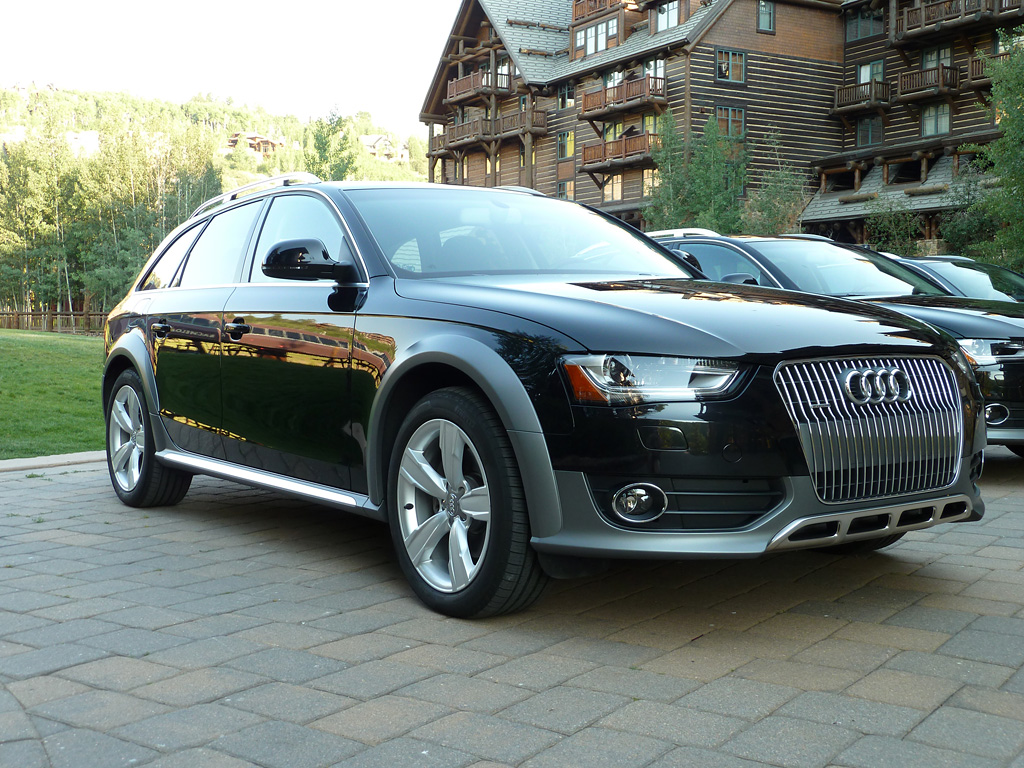
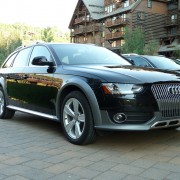
Audi allroad Review 2013


By Judy Colman

The hills around Denver, Colorado were alive with music, but not with the voices of the von Trapp family. This music emanates from the humming engines of Audi’s eighth version of their ‘B’ Segment lineup – the Audi A4, S4, A5, S5 and, again, the Audi allroad.
For 2013, Audi reintroduces the allroad, last available in the US in 2005. This new version replaces the A4 Avant in Audi’s model line. Now based on the A4 platform rather than the A6, the new allroad is faster and more energy efficient than its predecessor. A 211 horsepower, 2.0-liter, direct-injection I4, turbocharged engine provides plenty of oomph to tackle the Rockies while still delivering 23 (combined) mpg. 258 lb.-ft. of torque are generated at 1500 rpm. Audi links the 2.0T motor with an eight –speed Tiptronic automatic transmission. A manual transmission is not currently available. We tested quattro, Audi’s permanent all-wheel drive system, when afternoon thunderstorms all but obliterated the roadway. Grip on the slick, mountain curves never wavered on the standard 18-inch wheels shod with 245/45 all season tires.
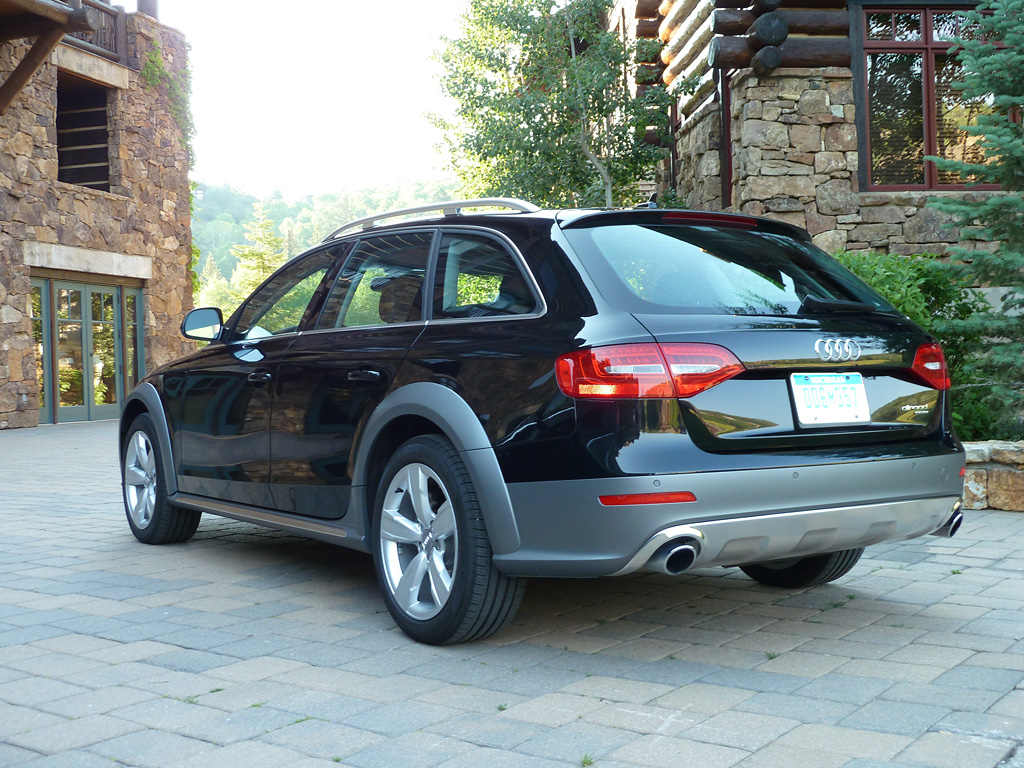
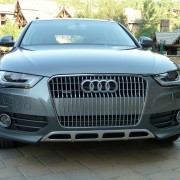
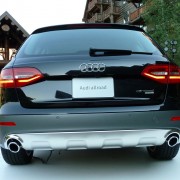
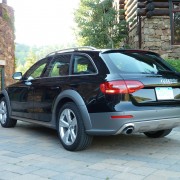
The 2013 allroad receives the distinctive Audi “Singleframe” grille with vertical chrome struts and angled upper corners. That feature appears also on all ‘B’ Segment cars for a homogeneous look. Newly designed headlamps, fog lamps, side mirrors, taillights, and exhaust add to the fresh appearance. The new allroad’s longer wheelbase adds ride comfort and an additional 1.5 inches of ground clearance. That and a widened track makes off road trekking a little easier. Body cladding, traditionally a matte finished gray/black is also available in full paint finish.

Technology abounds in the 2013 allroad. If you are travelling at less than 19 mph, the Audi Adaptive Cruise Control system can fully stop the car if it senses a collision. An electromechanical power steering system, Audi Dynamic Steering, replaces a traditional hydraulic system. It requires no additional energy from the engine, if it is travelling in a straight line, and thereby reduces emissions. Factory installed wireless internet, called Audi Connect, a 3G online connection, is now available on the allroad as well as all ‘B’ Segment models. Paired with Audi’s MMI Navigation, Google Earth maps will be joined in 2013 with Google’s street view technology. While you’re busy looking at the mountain scenery, your tech-obsessed passengers can take full advantage of their electronic toys. Your allroad is now a Wi-Fi hotspot capable of connecting up to 8 devices. Who said the hills aren’t alive with music, and games, and movies, and texting?
Despite the fact that the 2013 allroad is now based on the smaller A4 platform, overall height increases by 2.3 inches offering more front passenger headroom than in previous models. Driver seat memory, heated front seats, a panorama sunroof, and an available sports interior package welcome passengers. The revised instrument cluster looks modern and crisp. Fold down the 40/60 split rear seat and load the 50.5 cu. ft. of cargo space with everything you need for your mountain adventure. Interior design is sophisticated and refined. Standard leather seating alone puts allroad ahead of its rivals, notably the BMX 328i xDrive and the larger Volvo XC70.

Three trim levels of the 2013 allroad are available: the Premium starting at $39,600, the Premium Plus starting at $42,900, and the Prestige model at $48,800.
Because the 2013 allroad has few competitors in the market, Audi is betting the American public is again ready for this revised version. As an alternative to the crossover or small SUV, the Audi should appeal to anyone needing a little extra space without compromising handling and comfort. The hills may not be alive with “Do-Re-Mi” but maybe with a little Zac Brown Band, or Black-Eyed Peas, or the sweet sound of a 2.0T motor humming up a mountain pass.

BMW 650i Coupe Review 2012


By David Colman
For: Do-It-All Nature, Space, Grace, Pace
Against: Exterior Rear View Mirrors Too Small
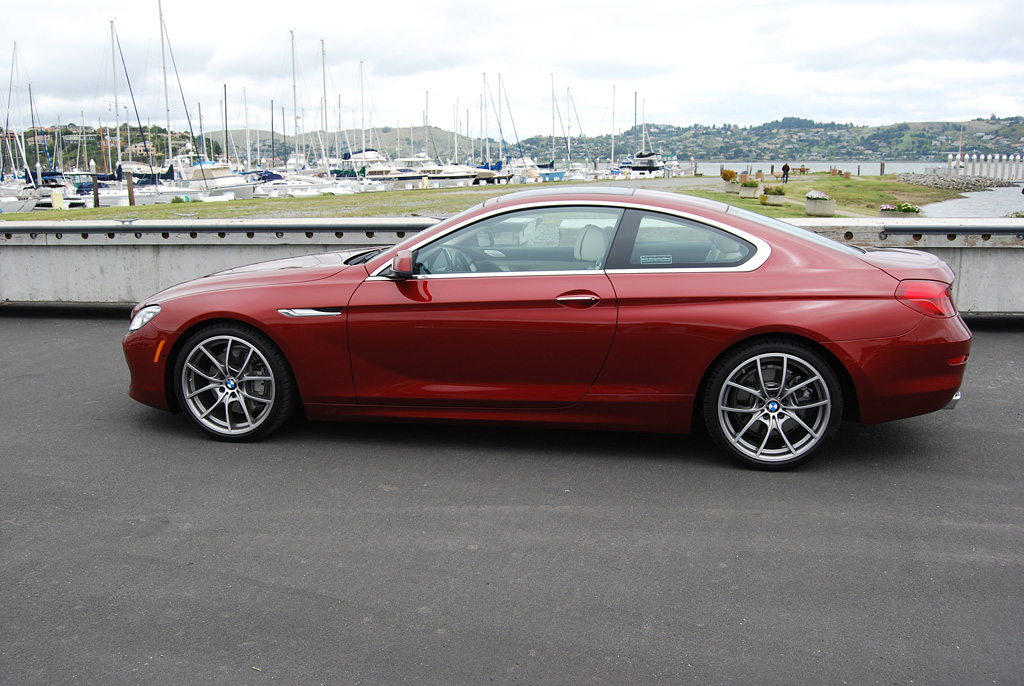
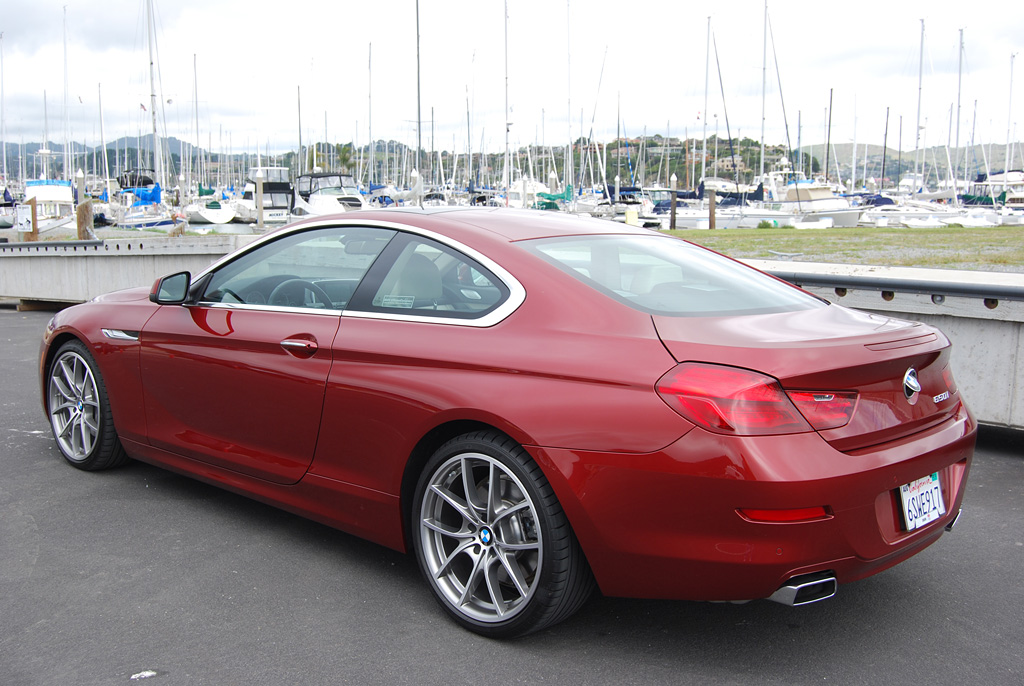
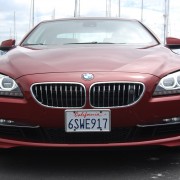
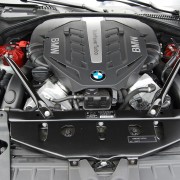
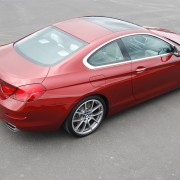
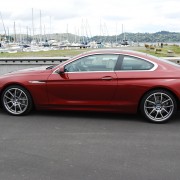
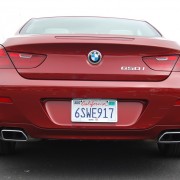
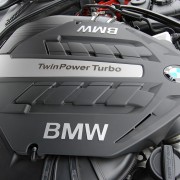
If you need a sportscar and a high performance sedan, look no further than Bimmer’s 650i. Granted, it’s a tad pricey at $101,675. But if you perceive it as 2 cars in 1, you’re on the right reasoning track. If you’re willing to alot $50,000 for each purpose the 650i fulfills, then you’ve saved yourself from buying an extra car. Let’s examine this genteel beast from the sportscar perspective first. Are 400hp and 450 lb.-ft. of torque enough to slake your thirst for V8 twin turbo power? They should be, considering the 650i will turn 107mph in 13.4 seconds through the quarter mile, and post a 0-60mph time of 5.1 seconds on its way to an electronically limited top speed of 150mph. If that isn’t serious sportscar territory, than nothing is.
But what about the handling? In a word, superb. BMW’s Driving Dynamics Control (DDC) system, which is standard on this car, allows you to dial up just the right amount of steering feedback, suspension control, throttle response and traction control permissiveness you need when pushing the performance envelope. An easily accessible button on the standard “Fine Line Oak Wood” center console allows you to bump the default DDC setting from Comfort to Performance or Performance+. If you hold the button down for 10 seconds in the Performance+ setting, you disable Dynamic Stability Control (DSC), putting your enthusiasm and talent in control of the situation. You’ll want to be exceptionally careful in this DSC-deleted Performance+ mode, because many of the safety net override systems are disabled, making it possible to lose control of this heavy and powerful vehicle if you don’t know what you’re doing.
 
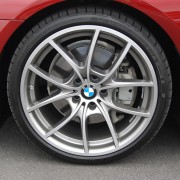
Even though it weighs 4,380 pounds, the 650i feels much more agile than its weight would lead you to believe. That’s because a number of optional systems work in consort seemingly to defy the limits imposed by mass and gravity. Leading the way is Integral Active Steering ($1,750) which really translates into 4-wheel-steering. As you enter a turn, the rear wheels cock slightly in the direction of the turn to augment the adhesion of the huge 20 inch diameter alloys and Dunlop Sport Maxx run-flat DSST tires (245/35/20 front, 275/30/20 rear) which are standard on this model. At 37mph, rear wheel steering turn entry enhancement ends. Further aiding handling agility is the ingenious Active Roll Stabilization ($2,000), which tailors anti-sway bar tension according to need. The faster you drive, the stiffer the sway bars become.
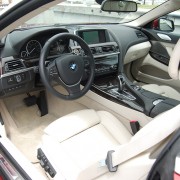
Now let’s examine this coupe’s contribution to family harmony. Although access to the rear seats is by definition limited in any 2-door vehicle, this BMW does its best to make back seat usage feasible and comfortable for all concerned. An oversized latch on the top of the front seats allows back seaters to tilt their way into the plush pair of rear lounge chairs. Even better are the exquisitely crafted front 20-way power Multi-contour chairs, complete with Nappa leather covering and optional ($500) 3-stage heaters. The commodious 16.1 cubic foot trunk, unencumbered by the need to house a spare tire thanks to the run=flat Dunlops, will hold enough baggage to take three adults and their suitcases across country. And what a fine trip it promises to be. On the open highway, the twin turbo V8 settles into a relaxed gate that nets you 23 MPG. Slip the Dynamic Driver Control system into Comfort+ mode, and the 650 metamorphoses from a backroad burner to a freeway cruiser extraordinaire. The optional Bang & Olufsen Premium Sound Package ($3,700) provides an endless array of entertainment options, from 1 year of free Sirius Radio to iPod and USB integration. So if you need a concert hall on wheels with the ride comfort of a ‘60s Cadillac, then give this Bimmer a close look. Because it’s the very same car that will run with a Turbo Porsche on any backroad of your choice.

2012 BMW 650i Coupe
  • Engine: 4.4 liter V8, Direct Injected and Twin Turbocharged
  • Horsepower: 400hp at 5,500rpm
  • Torque: 450lb.-ft. at 1,750rpm
  • Fuel Consumption: 15 MPG City/23 MPG Highway
  • Price as Tested: $101,675
  • Star Rating: 9.5 out of 10 Stars
2012 BMW 650i Coupe2012 BMW 650i Coupe2012 BMW 650i Coupe

2012 BMW 650i Coupe2012 BMW 650i Coupe2012 BMW 650i Coupe2012 BMW 650i Coupe2012 BMW 650i Coupe2012 BMW 650i Coupe

Posted by: D.Colman

Selasa, 17 Juli 2012

Audi A8 Hybrid New 2013

2013 Audi A8 Hybrid
If silent travel is chief among your priorities for an ecofriendly vehicle, the Audi A8 hybrid is not for you. There isn’t much in the way of quiet, electric-only operation, which makes sense, of course, given that this isn’t a fully electric car. (You can run solely on electrons for about two miles at a constant 37 mph, and if you awaken the engine, EV mode will reengage automatically when you relax on the accelerator. Top speed in all-electric mode is 62 mph.) And although you might never notice its internal-combustion heart beating if you dawdle at or below the pace of traffic, the engine brings attention to itself with a subdued but noticeable growl once you call for any real power.
The sucking, squeezing, banging, and blowing noises come from the VW Group’s ubiquitous 211-hp, 2.0-liter four-cylinder, teamed here with a 54-hp electric motor that’s integrated with a ZF eight-speed automatic transmission. Electrical storage capacity is provided by a 1.3-kWh lithium-ion battery pack. Power is sent only to the front wheels. Combined and at full steam, the powertrain delivers 245 hp and 354 lb-ft of torque. This system is almost identical to the one offered in the A6 and Q5 hybrids.
We Suppose That’ll Do
We estimate the A8 hybrid can reach 60 mph in about 7.2 seconds; Audi claims a drag-limited top speed of 146 mph. It is not governed, and we found you can easily reach 155 or more mph on downhill sections of the German roads on which we drove. This kind of performance should be sufficient for most markets and customers. But it does not compare to the relentless power you feel when you step on the throttle of the 2011–12 BMW ActiveHybrid 7 (since neutered for 2013) or Lexus LS600hL. Nevertheless, piloting this A8 can be satisfying for hybrid lovers who drive without urgency. At that point, this A8’s hybrid system goes about its business unobtrusively. Up to 99 mph, you can do what VW Group brands like to call “sailing,” that is, if you take your foot off the gas, the electric motor doesn’t aggressively recapture energy, allowing for a smoother coasting experience. You’ll be all smiles at the gas station. At 37 mpg in the European combined cycle, the A8 hybrid is the most efficient gasoline-powered luxury sedan. For comparison, on the same test cycle, the Mercedes-Benz S400 hybrid gets 30 mpg, the LS600hL returns 25 mpg, and the 2011–12 ActiveHybrid 7 achieved 25 mpg. (We estimate ratings for the A8 hybrid on the somewhat more realistic EPA cycle at 24 mpg city and 34 highway.)

During spirited driving, you can feel the electric motor lending a hand, a welcome boost during quick passing maneuvers as long as the batteries aren’t depleted, which happens all too quickly. As for when the road begins to bend, it isn’t much fun to test the A8 hybrid’s limits. We love piloting any A8—and we include the sporty S8 here—and it’s our reigning champion in the segment, but this is the least dynamic of the bunch. Even with 290-ish pounds of hybrid gear, at an estimated 4150 pounds, the car isn’t very heavy versus its competition. But with power routed only to the front wheels, this hybrid relentlessly and gracelessly pushes through corners; we wished for Quattro. There is only one other front-drive A8 variant: the Europe-only 204-hp, 3.0-liter V-6 diesel version, which incidentally gets even better combined mileage than the hybrid at 39 mpg on the EU cycle. The brakes are relatively numb, but the transition from electric recuperation to hydraulic braking is well camouflaged.
Other A8s Make More Sense
Otherwise, the A8 hybrid is an exceedingly comfortable long-distance cruiser, and its four-cylinder-based powertrain is sufficient if performance and bragging are not your main objectives. But how much sense does the hybridization make? Its drawbacks include extra weight and complexity, the gas tank shrinks from 23.8 to 19.8 gallons, and trunk space is down from 18 cubic feet to a far-less-usable 11.8.
Audi is bullish about the A8 hybrid's potential in the European market and particularly in China, but it doesn’t believe enough buyers could be found in the U.S. to justify bringing it here. In Europe, it costs less than the 372-hp, 4.2-liter V-8 Quattro but more than the diesel 3.0 TDI with either front-wheel drive or Quattro, as well as the 290-hp version of the gas-fired 3.0T Quattro. All of these, in our opinion, would be more attractive choices, and American A8 buyers looking to scratch an efficiency itch will get by just fine with the 3.0-liter diesel model scheduled to arrive in the next year or so.

July 2012 || BY JENS MEINERS || MULTIPLE PHOTOGRAPHERS